![HR Logo [Recovered]_Full Color Vertical-1](https://blog.healthyroster.com/hs-fs/hubfs/HR%20Logo%20%5BRecovered%5D_Full%20Color%20Vertical-1.png?width=199&height=178&name=HR%20Logo%20%5BRecovered%5D_Full%20Color%20Vertical-1.png)
 By
By
When evaluating an athlete after a suspected concussion, is it better to compare post-injury performance with normative data or with the athlete’s own baseline?
 Both approaches can provide useful information, but they answer different questions.
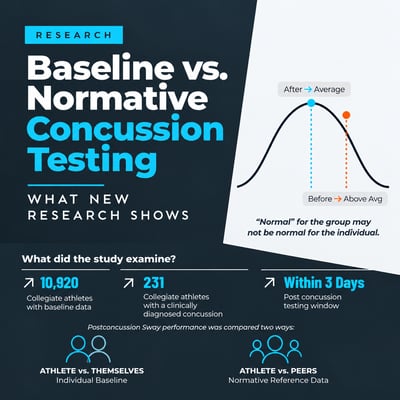
Normative data shows how an athlete’s performance compares with other athletes. An individual baseline shows how that athlete compares with their own preinjury performance.
New research published in the Orthopaedic Journal of Sports Medicine examined that distinction using the Sway Sports+ test battery.
Researchers found that individualized baseline comparisons identified a greater percentage of concussed athletes with impaired performance than comparisons with normative values.
What is the difference between baseline and normative concussion testing?
The difference comes down to the point of comparison.
Normative data asks: How does this athlete compare to their peers?
An individual baseline asks: How does this athlete compare to themselves before the injury?
That distinction can matter after a concussion. An athlete who performs well above average before an injury could experience a meaningful decline in performance but still score within the “normal” range when compared with peers. Baseline Concussion Testing Res…
Put simply, “normal” for the group may not be normal for the individual.
What did the concussion study examine?
 Researchers analyzed Sway performance among collegiate athletes ages 18–22.
The study included 10,920 collegiate athletes with baseline data and 231 athletes with a clinically diagnosed concussion. Postconcussion testing occurred within three days of injury. Researchers compared postconcussion Sway performance in two ways: against each athlete’s individual baseline and against normative reference data. Baseline Concussion Testing Res…
This allowed researchers to examine whether individualized baseline comparisons and normative comparisons identified impairment differently following concussion.
Did individual concussion baselines identify more impairment?
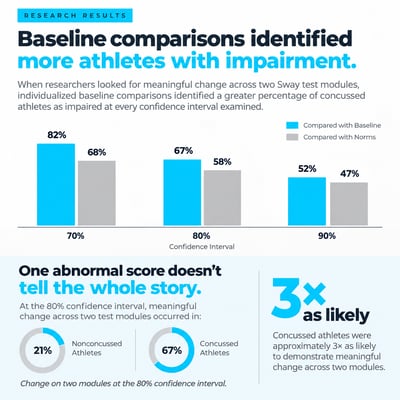
Yes. In this study, individualized baseline comparisons identified a greater percentage of concussed athletes as impaired than normative comparisons at every confidence interval examined. Baseline Concussion Testing Res…
That's an important distinction for Athletic Trainers and other healthcare professionals evaluating athletes after a suspected concussion.
Normative data can provide useful context, particularly when an individual baseline isn't available. But these findings suggest that an athlete's own preinjury performance can provide additional individualized context that comparison with peers may miss.
Why shouldn't concussion assessment rely on one abnormal score?
The study also demonstrates the importance of considering patterns across multiple areas of performance rather than focusing on a single score.
At the 80% confidence interval, 58% of nonconcussed athletes showed meaningful change on at least one test module during baseline retesting. Meaningful change across two modules, however, was much less common.
That occurred in:
- 21% of nonconcussed athletes
- 67% of concussed athletes
In other words, concussed athletes were approximately three times as likely to demonstrate meaningful change across two modules. Baseline Concussion Testing Res…
For Athletic Trainers, that reinforces an important principle: concussion assessment should consider patterns across multiple measures and the broader clinical picture, not a single test result.
Were concussion symptoms responsible for the findings?
No. Symptom scores were intentionally excluded from the study's analysis.
The findings were based on Sway Concussion's objective balance and four cognitive measures. Baseline Concussion Testing Res…
That makes the findings particularly relevant when considering the role objective assessment can play alongside symptom reporting, clinical examination, and professional judgment.
What should Athletic Trainers know about baseline concussion testing?
The research points to three practical takeaways:
- Individual baselines provide individualized context. Normative data is useful, but an athlete's own baseline may reveal postinjury changes that comparison with peers can miss.
- Look for patterns, not a single score. Considering multiple areas of performance can help distinguish meaningful change from normal variability.
- Objective data adds another piece to the assessment. Balance and cognitive performance can provide valuable information alongside symptoms, clinical examination, and professional judgment. Baseline Concussion Testing Res…
The bottom line
Concussion is individual. Baseline testing helps make the comparison individual, too.
This research provides evidence supporting the clinical utility of individualized baseline comparisons and multimodal assessment when evaluating suspected concussion.
Sway Concussion gives Athletic Trainers access to objective balance and cognitive assessment tools from a mobile device, helping make baseline and postinjury testing easier to incorporate into their concussion management process.
Want the research at a glance? Download our two-page Sway Research Brief for a quick look at the study, findings, and key takeaways for Athletic Trainers.
Research referenced: Schatz P, Chikar J. Comparing Postconcussion Sway Balance and Cognitive Test Performance With Preinjury Baseline Identifies a Higher Percentage of Impaired Concussed Athletes Than Comparison With Normative Values. Orthopaedic Journal of Sports Medicine. 2026;14(7). Study population: Collegiate athletes ages 18–22. Baseline Concussion Testing Res…
Important: Sway Concussion is an assessment aid and is not intended to independently diagnose concussion. Concussion diagnosis and management require evaluation by a qualified healthcare professional.